
Chinese to English NAATI Translations – What New Migrants Need to Know

China has been Australia's largest source of permanent migrants for over a decade. From software engineers relocating to Melbourne on skilled visas to families reuniting through parent visa pathways, hundreds of thousands of Chinese nationals have built lives in Australia - and almost all of them have needed at least one official document translated along the way. The process is straightforward once you understand how it works, but China's unique documentation system adds layers of complexity that many new arrivals do not expect.
Australian authorities - from the Department of Home Affairs to state road agencies and professional registration bodies - require translations to be completed by a NAATI certified translator. This guide explains the key Chinese documents that typically need translating, how the notarial certificate system works, and the practical details of working with a NAATI certified Chinese translation service.
Why Chinese Documents Specifically Require NAATI Certification
NAATI - the National Accreditation Authority for Translators and Interpreters - certifies translators across dozens of language pairs, and Chinese (both Mandarin and Cantonese pathways) is one of the most in-demand. A NAATI certified translation includes the translator's unique practitioner number, an official stamp, and a signed declaration. This is what distinguishes it from an informal or community translation.
The distinction matters because Chinese documents present particular challenges for Australian institutions. Characters that look similar can have entirely different meanings. Names must be romanised to match passport spellings. Administrative terminology - from provincial government titles to education department classifications - requires specialist knowledge. An uncertified translator may produce a readable English text, but without the professional accountability that NAATI certification provides, the translation is unlikely to be accepted by any official body.
In practice, NAATI certified Chinese translations are required for visa lodgement, university enrolment, skills assessments, licence conversions, court proceedings, and professional registration across Australia.
The Notarial Certificate System
This is where Chinese documents diverge significantly from those of most other countries. Before a Chinese document can be used overseas, it typically needs to be notarised by a 公证处 (Notary Public Office). The notary office issues a 公证书 (notarial certificate) - a bound booklet that contains a certified copy of the original document, a notarial declaration confirming its authenticity, and an official red seal.
This means that when a Chinese national submits a birth certificate or degree for translation, it usually arrives not as a single page but as a multi-page booklet. The cover of the notarial certificate, the notary's declaration, and the document itself all need to be translated. Submitting only the inner document page and omitting the notarial wrapper is a common oversight that can result in the translation being rejected.
Another feature of the Chinese system is the 户口簿 (household registration book). This document records every member of a household at a registered address and has historically been central to Chinese administrative life. While it is not always required for Australian visa applications, it may be requested as supporting evidence to establish family relationships, particularly for parent visa or family reunion applications.
Birth Certificate
The Chinese birth certificate - formally known as the 出生医学证明 (Medical Certificate of Birth) - is issued by the hospital where the birth took place. The current standardised format has been in use since the mid-1990s, though the design has been revised several times. For anyone born before this system existed, a notarised birth declaration from the local notary office typically serves as the equivalent document.
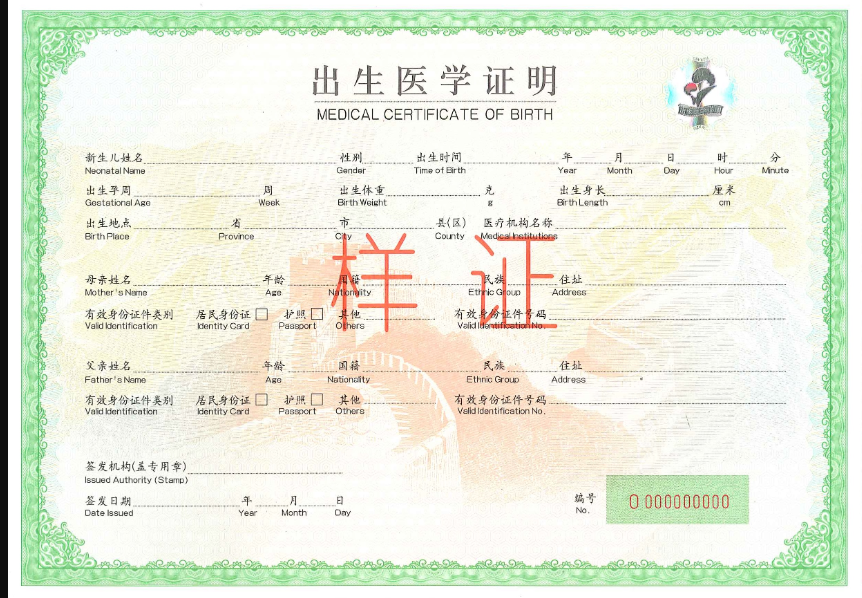
One of the most important translation considerations is the romanisation of Chinese names. The pinyin spelling in the translation must match what appears in the applicant's Chinese passport. This sounds simple, but discrepancies arise more often than you might expect - particularly where older documents use Wade-Giles romanisation, where compound surnames are involved, or where given names have been reordered for English-speaking contexts.
Multilingual Example - Chinese Birth Certificate
Original (Chinese):
姓名:张明华
性别:女
出生日期:1997年11月22日
出生地点:北京市朝阳区妇幼保健院
父亲:张建华
母亲:刘芳
Certified Translation (English):
Name: Zhang Minghua
Sex: Female
Date of Birth: 22 November 1997
Place of Birth: Chaoyang District Maternal and Child Health Hospital, Beijing
Father: Zhang Jianhua
Mother: Liu Fang
What Can Go Wrong
Hospital names and district names in China have changed over the decades as administrative boundaries have been redrawn. A birth hospital from the 1980s may no longer exist under that name today. A good translator will translate the name as it appears on the document while noting any known current equivalents. Additionally, the notarial certificate wrapping the birth certificate must be translated in full - cover, declaration, and all seals.
Marriage Certificate
The Chinese marriage certificate - 结婚证 - is a distinctive small red booklet issued by the local Civil Affairs Bureau (民政局). Two identical copies are issued, one for each spouse. For overseas use, a marriage notarial certificate (结婚公证书) is typically obtained from the local 公证处, which wraps the marriage information in the standard notarial format.
Partner visa applicants (subclass 309/100 or 820/801) are the most frequent users of this translation, but it also appears in family court matters, superannuation death benefit claims, and applications to register a name change through state registries. Unlike many Western marriage certificates, the Chinese version does not include witness signatures or details of the ceremony - it is purely an administrative registration record.
Multilingual Example - Chinese Marriage Certificate
Original (Chinese):
持证人:张明华
配偶:李强
登记日期:2022年5月20日
登记机关:北京市朝阳区民政局
结婚证字号:J110105-2022-005678
Certified Translation (English):
Certificate Holder: Zhang Minghua
Spouse: Li Qiang
Date of Registration: 20 May 2022
Registration Authority: Chaoyang District Civil Affairs Bureau, Beijing
Marriage Certificate No.: J110105-2022-005678
Police Certificate
Character requirements are a standard component of Australian visa applications. If you have lived in China for 12 months or more since turning 16, you will need a police certificate - known as 无犯罪记录证明 (Certificate of No Criminal Record). This is issued by the Public Security Bureau (公安局) in the jurisdiction where you were last registered, and it must be notarised for overseas use.
The process for obtaining this certificate can be complex for applicants who have lived in multiple Chinese cities or provinces, as the certificate is jurisdiction-specific. Some applicants obtain it through a family member in China or via the Chinese embassy or consulate in Australia, though processing methods and timeframes vary.
Multilingual Example - Chinese Police Certificate
Original (Chinese):
无犯罪记录证明
姓名:张明华
身份证号:110105199711220045
经查,在我辖区内未发现违法犯罪记录。
Certified Translation (English):
Certificate of No Criminal Record
Name: Zhang Minghua
ID Card No.: 110105199711220045
Upon investigation, no record of criminal offence has been found within our jurisdiction.
The 18-Digit Identity Number
Every Chinese police certificate includes the holder's 身份证号 - an 18-digit national identity card number that encodes their registered place of birth, date of birth, and a verification digit. This number appears on virtually every Chinese official document and acts as a cross-referencing tool for Australian immigration caseworkers. It must be transcribed character-for-character in the translation without any formatting changes.
Education Documents - The Dual-Certificate System
This is one of the areas where Chinese qualifications differ most from the Australian system. When a student completes a degree in China, they receive two separate documents: the 毕业证书 (graduation certificate, confirming completion of the programme) and the 学位证书 (degree certificate, conferring the academic award). They are not interchangeable. Australian skills assessment bodies such as VETASSESS, Engineers Australia, and the Australian Computer Society generally require certified translations of both documents, plus the academic transcript (成绩单).
Degree classifications also follow a different structure. Chinese universities award 学士 (Bachelor's), 硕士 (Master's), and 博士 (Doctoral) degrees, but the prefix denotes the field - 工学学士 (Bachelor of Engineering), 理学硕士 (Master of Science), 文学学士 (Bachelor of Arts). Translators need to produce English equivalents that are recognisable to Australian assessors without distorting the original terminology.
Multilingual Example - Chinese Degree Certificate
Original (Chinese):
学位证书
姓名:张明华
专业:国际经济与贸易
学位:经济学学士
授予日期:2019年6月25日
Certified Translation (English):
Degree Certificate
Name: Zhang Minghua
Major: International Economics and Trade
Degree: Bachelor of Economics
Date Conferred: 25 June 2019
Driving Licence
The Chinese driving licence - 机动车驾驶证 - consists of a credit-card-format main licence plus a separate paper record (副页) that contains administrative details. Both components should be translated. The licence is issued by the Traffic Management Bureau (交通管理局), a division of the Public Security Bureau, and the most common category for passenger vehicle drivers is C1.
Australian states allow new arrivals to drive on their overseas licence for a limited period - typically three to six months, depending on the state. After that, a local licence is required. VicRoads in Victoria, Transport for NSW, and the Department of Transport and Main Roads in Queensland all require a NAATI certified translation as part of the conversion application. Some states also require a driving test regardless of your overseas experience.
Multilingual Example - Chinese Driving Licence
Original (Chinese):
机动车驾驶证
姓名:李强
准驾车型:C1
有效期限:2020年03月15日至2026年03月15日
发证机关:北京市公安局公安交通管理局
Certified Translation (English):
Motor Vehicle Driving Licence
Name: Li Qiang
Permitted Vehicle Type: C1 (Small motor vehicle)
Validity: 15 March 2020 to 15 March 2026
Issuing Authority: Beijing Municipal Public Security Bureau, Traffic Management Bureau
Other Chinese Documents That Frequently Need Translation
Beyond the core documents covered above, NAATI certified Chinese translators regularly handle:
- 户口簿 (Household Registration Book) - Records all family members at a registered address. May be requested for parent visa applications or to establish family relationships. Each page relating to the relevant family member needs translation.
- 离婚证 / 离婚判决书 (Divorce Certificate / Divorce Judgment) - Administrative divorces produce a certificate from the Civil Affairs Bureau; contested divorces result in a court judgment. Either may be needed for partner visa applications where a previous marriage has ended.
- 工作证明 / 在职证明 (Employment Certificate) - Issued by an employer to confirm position, tenure, and responsibilities. Used extensively for skills assessments and points-tested visa applications.
- 体检报告 (Medical Report) - While Australian panel physicians conduct their own health assessments, translated Chinese medical records may be needed in specific circumstances, such as pre-existing condition declarations.
- 房产证 (Property Ownership Certificate) - Occasionally required for business or investment visa applications to demonstrate financial capacity.
How the Translation Process Works
Getting Chinese documents translated for Australian use is an entirely online process. You do not need to visit an office, and there is no requirement to post original documents.
- Capture every page of the notarial certificate. For Chinese documents, this means all pages of the 公证书 - the cover, the notary declaration, and the document page(s). For a driving licence, include both the main card and the paper 副页. Use a scanner or take clear photographs in good lighting.
- Upload through a certified translation service. Specify the document type and mention if there are any known name spelling variations between documents.
- A NAATI certified Chinese translator completes the work. The translator renders the full document into English, applies their NAATI practitioner number and stamp, and provides a signed declaration of accuracy.
- Receive your translation digitally. The certified translation is delivered as a PDF, ready to upload to ImmiAccount, submit to a university, or forward to a skills assessment body.
Digital Delivery Is the Norm
The Department of Home Affairs, Australian universities, and professional bodies accept NAATI certified translations delivered as digital PDFs. Hard copies are only needed where an authority specifically requires them - which is increasingly rare. For more on this, see our guide on digital versus hard copy NAATI translations.
Chinese Translation Pricing in Australia
The cost of translating Chinese documents depends on the service type and the complexity of the source material. Notarial certificates with multiple pages will typically cost more than a single-page document.
| Service Type | Starting From | Typical Turnaround |
|---|---|---|
| Self-Service Extract | $44.95 | From 1 hour |
| Extract Translation | $59.95 | 1 business day |
| Full Translation | $64.95 | 1-2 business days |
Turnaround times are indicative and not guaranteed. Multi-page notarial certificates, documents with handwritten entries, or poor-quality scans may require additional processing time. When comparing providers, check whether the quoted price includes the full notarial certificate or only the inner document - this is a common source of unexpected additional charges.
Mistakes That Cost Time and Money
These are the issues that most frequently cause delays or rejections for Chinese document submissions in Australia:
- Only translating the document page inside the notarial certificate. The 公证书 is a complete legal instrument. The cover, declaration page, and document page all need to be translated. Submitting a translation of only the inner page is one of the most common reasons for rejection.
- Submitting the graduation certificate without the degree certificate. China's dual-document system (毕业证书 + 学位证书) is unfamiliar to many Australian assessors. Both documents are needed, and skills assessment bodies will ask for the missing one if only one is provided.
- Pinyin name mismatches. If the romanised spelling in your translation does not match your passport, it can trigger identity verification delays. Ensure your translator knows exactly how your name appears in your passport.
- Forgetting the 副页 (paper record) of the driving licence. The main card is only half the document. The paper supplement contains administrative details that road authorities need to see.
- Low-resolution scans of documents with red seals. Chinese official seals (印章) are printed in red ink that can fade or blur in poor-quality photographs. If the seal text is illegible, the translator may not be able to include it in the translation, potentially raising questions about the document's authenticity.
Frequently Asked Questions
Do I need to translate the entire notarial certificate or just the document inside?
The entire notarial certificate. Australian authorities expect translations of the cover page, the notary's declaration, and the document itself. The notarial wrapper is a legal instrument that authenticates the enclosed document - omitting it renders the translation incomplete.
My document is in Traditional Chinese - can a Mandarin translator handle it?
Traditional and Simplified Chinese are written scripts, not spoken languages. A NAATI certified Chinese translator is qualified to work with both scripts. The translation into English is the same regardless of which script the source document uses.
Will I need to translate my hukou (户口簿)?
It depends on the visa subclass and the supporting evidence you are providing. Parent visa applications and family reunion cases sometimes require hukou translations to establish family relationships. Check with your migration agent or the Department of Home Affairs for your specific situation.
Can I upload a digital NAATI translation to ImmiAccount?
Yes. The Department of Home Affairs accepts NAATI certified translations uploaded as PDF files through ImmiAccount. There is no requirement to submit hard copies unless the department specifically requests them in writing.
What is the difference between an extract and a full translation?
An extract translation covers the key data fields - names, dates, identification numbers, and document references. It is suitable for most visa and administrative submissions. A full translation reproduces every element of the original, including all stamps, seals, handwritten notes, and notarial declarations. Full translations are typically chosen for court proceedings, complex legal matters, or multi-page notarial certificates where completeness is essential.
Need a Chinese Document Translated?
Upload your document - including all pages of any notarial certificate - through our simple online process. A NAATI certified Chinese translator will handle the rest. If you are unsure which service level suits your document, send through a copy and we will advise on the best option.
About the Author
Sarah Chen
NAATI Certified Chinese-English Translator | Migration Document Specialist
Sarah is a NAATI certified Chinese-English translator with eight years' experience in Simplified and Traditional Chinese civil and academic documents. She holds a Master of Translation and Interpreting.