
German to English NAATI Translations – What New Migrants Need to Know

Whether it is a mechanical engineer from Stuttgart applying for skills recognition through Engineers Australia, a nurse from Vienna preparing registration paperwork for AHPRA, or a dual citizen from Zurich lodging a citizenship application - the starting point is usually the same. Australian authorities need to read your documents, and if those documents are in German, they need a certified English translation before anything moves forward.
This guide breaks down the German-language documents most commonly submitted in Australia, explains how the civil registration systems in Germany, Austria, and Switzerland work, and walks through the practical steps involved in getting a NAATI certified German to English translation.
Why NAATI Certification Matters for German Documents
NAATI stands for the National Accreditation Authority for Translators and Interpreters. It is the only body in Australia that certifies translators against a nationally recognised standard. When an Australian agency - whether it is the Department of Home Affairs, a state licensing body, or a university admissions office - asks for a "certified translation," they are referring to one produced under NAATI credentials.
A translation done by a bilingual colleague, a sworn translator registered only in Germany, or an automated tool does not carry NAATI certification and will typically be rejected. The NAATI stamp and practitioner number serve as proof that a qualified professional has taken responsibility for the accuracy of the English version.
This applies across the board - from a Geburtsurkunde submitted with a partner visa application to a Zeugnis sent to a skills assessment authority. If the receiving organisation operates in Australia, NAATI certification is almost certainly what they expect.
Understanding the Standesamt - Germany's Civil Registry
Every German municipality has a Standesamt (civil registry office), and it is this office - not a church, not a hospital, not a court - that officially records births, marriages, and deaths. If you were born in Hamburg, your birth was registered at the Standesamt Hamburg. If you married in Munich, the Standesamt München holds the record.
A significant change came in 2009 when Germany overhauled its civil status law (Personenstandsgesetz). Before that date, records were kept in handwritten register books. Post-reform certificates are standardised printed documents drawn from electronic databases. Both remain legally valid, but the visual difference is stark - and older handwritten entries sometimes include archaic phrasing or regional abbreviations that require careful handling during translation.
Austria runs a parallel system through its own Standesamt, while in Switzerland the equivalent is the Zivilstandsamt. Although the three countries share a language, their administrative structures, legal terminology, and certificate layouts diverge in ways that matter for accurate translation.
Birth Certificate - Geburtsurkunde
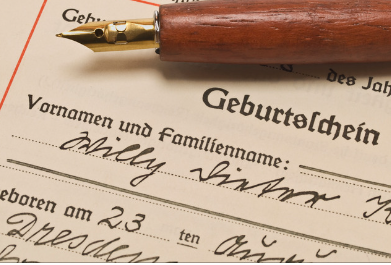
The Geburtsurkunde is typically the first document people reach for when beginning an Australian visa or citizenship application. It records the child's name, date and place of birth, and the parents' full names and occupations. Older versions may also list religious denomination (Religionszugehörigkeit).
Unlike countries that issue short-form and long-form birth certificates, Germany generally produces a single standard format. However, a beglaubigte Abschrift aus dem Geburtenregister (certified extract from the birth register) can include marginal annotations (Randvermerke) - notes added over time to record subsequent events like marriage, divorce, or adoption. These annotations are legally significant and must be translated in full.
Side-by-Side Example - Geburtsurkunde
German Original:
Familienname: Hartmann
Vorname(n): Lukas Alexander
Geburtstag: 17. März 1993
Geburtsort: Düsseldorf, Nordrhein-Westfalen
Vater: Stefan Hartmann
Mutter: Sabine Hartmann, geb. Fischer
English Translation:
Surname: Hartmann
Given Name(s): Lukas Alexander
Date of Birth: 17 March 1993
Place of Birth: Düsseldorf, North Rhine-Westphalia
Father: Stefan Hartmann
Mother: Sabine Hartmann, née Fischer
Translation Pitfalls
German compound words are a well-known feature of the language, and civil documents are full of them - Geburtsstandesamt, Personenstandsregister, Religionszugehörigkeit. These need to be unpacked rather than rendered literally. The abbreviation geb. (short for geborene) denotes a maiden name and should be translated as "née." Place names also require care: Frankfurt am Main and Frankfurt an der Oder are two entirely different cities, and getting them wrong has real consequences for identity verification.
Marriage Certificate - Eheurkunde
Civil marriage in Germany must take place at the Standesamt. Any church or religious ceremony is purely personal - it has no legal effect. The resulting certificate, the Eheurkunde (or Heiratsurkunde in older documents), records both spouses' full names, birth details, the date and location of the civil ceremony, and the chosen married name (Ehename).
The Ehename field is particularly important for Australian applications. German name law (Namensrecht) offers several options after marriage: one spouse can take the other's surname, both can keep their birth names, or one can add the other's name with a hyphen. Australian case officers closely scrutinise name consistency across documents, so translating the Ehename and any Geburtsname (birth name) fields accurately is essential - especially for partner visa subclasses 309/100 and 820/801.
Side-by-Side Example - Eheurkunde
German Original:
Eheschließender: Lukas Alexander Hartmann
Eheschließende: Maria Elena Keller
Tag der Eheschließung: 5. Juli 2020
Ort: Standesamt Köln
Ehename: Hartmann
English Translation:
Husband: Lukas Alexander Hartmann
Wife: Maria Elena Keller
Date of Marriage: 5 July 2020
Place: Civil Registry Office, Cologne
Married Name: Hartmann
Police Clearance - Führungszeugnis
Germany's police clearance certificate is called the Führungszeugnis - literally a "certificate of conduct." It is not issued by the police themselves but by the Bundesamt für Justiz (Federal Office of Justice) in Bonn, which draws on the Federal Central Register (Bundeszentralregister). Applications can be lodged online through the Federal Office of Justice website or through a German diplomatic mission abroad.
There are several versions, and picking the right one matters. Belegart N is the standard domestic version for personal use. Belegart NE is the extended version, sometimes needed for roles involving children. Belegart O is the version issued specifically for overseas purposes - and this is what the Department of Home Affairs expects when assessing character for visa applications. Submitting the wrong type can delay your application.
Side-by-Side Example - Führungszeugnis
German Original:
Führungszeugnis (Belegart O)
Familienname: Hartmann
Vorname(n): Lukas Alexander
Der Inhalt des Bundeszentralregisters wurde überprüft. Es sind keine Eintragungen vorhanden.
English Translation:
Certificate of Good Conduct (Type O - for overseas use)
Surname: Hartmann
Given Name(s): Lukas Alexander
The contents of the Federal Central Register have been reviewed. No entries are recorded.
Austria and Switzerland Equivalents
Austrian nationals need a Strafregisterbescheinigung, obtainable from the Bundespolizeidirektion or online through Austria's central government portal. Swiss nationals require a Strafregisterauszug, available from the Federal Office of Justice in Bern. Although these documents serve the same purpose as the German Führungszeugnis, they use different terminology and formatting - a detail that needs to be reflected accurately in translation.
Academic Qualifications and Transcripts
Germany's higher education system has an excellent global reputation, but its qualification names can confuse Australian assessors who are unfamiliar with the structure. Under the Bologna Process (adopted from 2002), German universities now award Bachelor and Master degrees. Before Bologna, the standard qualification was the Diplom - a single-cycle degree typically spanning four to five years - or the Magister in humanities disciplines.
This distinction is critical. The German Diplom is not a "diploma" in the Australian or British sense - it is a full university degree generally considered equivalent to a Master's-level qualification. Mistranslating Diplom as "diploma" can result in your qualification being significantly undervalued by bodies such as VETASSESS, Engineers Australia, or the Australian Computer Society.
Germany also uses the Staatsexamen (state examination) for law, medicine, pharmacy, and teaching - a qualification that does not map neatly onto the Bachelor/Master framework. The grading scale adds another layer: 1.0 is outstanding, 4.0 is a bare pass, and 5.0 is a fail. None of this will be intuitive to an Australian assessor reading a translated transcript.
Side-by-Side Example - Academic Record
German Original:
Zeugnis über die Diplomprüfung
Fachrichtung: Elektrotechnik
Rheinisch-Westfälische Technische Hochschule Aachen
Gesamtnote: 1,9 (gut)
Datum: 15. Oktober 2016
English Translation:
Diploma Examination Certificate
Field of Study: Electrical Engineering
RWTH Aachen University
Overall Grade: 1.9 (Good)
Date: 15 October 2016
Driving Licence - Führerschein
German driving licences come in three historical formats: the old grey folding card, the pink paper licence, and the current EU-standard credit-card-sized version introduced in 2013. All remain legally valid in Germany, though the older formats are being progressively replaced. Each looks quite different, which can surprise Australian road authorities unfamiliar with European licence designs.
After arriving in Australia, German licence holders can drive for a limited period - typically three to six months depending on the state. Beyond that window, conversion to an Australian licence is required. In New South Wales, applications go through Transport for NSW. In Victoria, through VicRoads. In Queensland, through the Department of Transport and Main Roads. Each state requires a NAATI certified translation as part of the conversion process.
Side-by-Side Example - Führerschein
German Original:
Führerschein
Familienname: Hartmann
Vorname(n): Lukas Alexander
Fahrerlaubnisklasse: B
Erteilungsdatum: 10.04.2013
English Translation:
Driving Licence
Surname: Hartmann
Given Name(s): Lukas Alexander
Licence Category: B (Passenger vehicle)
Date of Issue: 10 April 2013
Austria, Switzerland, and Regional Differences
German is one language, but using it across three countries means navigating three distinct bureaucracies. Austrian certificates come from the Standesamt (same name as Germany), yet the terminology differs - Austrians sit the Matura rather than the Abitur, and their police clearance is a Strafregisterbescheinigung rather than a Führungszeugnis.
Switzerland adds another layer of complexity. With four official languages, the same type of certificate can arrive in German, French, Italian, or Romansh depending on the canton. German-language Swiss certificates are issued by the Zivilstandsamt and often include a field called Heimatort - the municipality of which a citizen is a registered member, separate from their birthplace or home address. This concept has no Australian equivalent and needs to be explained clearly in translation.
Regional Terminology at a Glance
Administrative divisions carry different names across all three countries: Bundesland in Germany, Kanton in Switzerland, and Bezirk in Austria. Educational qualifications also diverge - the Austrian Matura, the German Abitur, and the Swiss Maturität are comparable but not identical. A translator experienced with all three systems will handle these distinctions without introducing confusion.
Other Documents German Speakers Commonly Need Translated
Beyond birth, marriage, police, academic, and driving documents, there are several other items that German-speaking migrants regularly submit in Australia:
- Scheidungsbeschluss - The divorce decree, often required for partner visa applications or when remarrying. German divorce orders can run to many pages, particularly where property division (Zugewinnausgleich) or custody (Sorgerecht) is addressed.
- Meldebescheinigung - A registration certificate confirming a person's officially recorded address. Germany's mandatory address registration system (Meldepflicht) means this document is issued routinely and may be requested by Australian financial or administrative bodies.
- Arbeitszeugnisse - German employment references follow a highly formalised system of coded language. Phrases like "stets zur vollsten Zufriedenheit" (always to our fullest satisfaction) carry precise grading meaning that Australian employers and assessors will not pick up without proper translation context.
- Apostille - An internationally recognised authentication stamp. If your German document carries an Apostille (applied by the issuing German authority), the Apostille text itself must also be included in the certified translation.
- Aufenthaltstitel - A German residence permit. Relevant if you held residency in Germany before migrating and need to document your immigration history for Australian purposes.
Getting Your German Documents Translated
The entire process is handled online - there is no need to attend an office or post physical documents.
- Scan or photograph your document clearly. All text, stamps, seals, and any marginal notes should be fully legible. Older formats - the grey folding driving licence, handwritten Standesamt records, or DDR-era certificates - benefit from a flatbed scanner rather than a phone photo.
- Upload through a translation service. Submit the file through a NAATI certified translation provider and select the appropriate service level.
- A NAATI certified translator completes the work. The translator produces the English version, certifies it, and appends their NAATI practitioner number and stamp.
- Receive the finished translation digitally. The certified translation is delivered as a PDF. Australian authorities broadly accept digitally delivered NAATI certified translations - physical copies are only needed if a specific organisation explicitly requests them.
Digital Delivery Is Standard
The Department of Home Affairs accepts PDF uploads through ImmiAccount, and most universities and skills assessment bodies are equally comfortable with digital certified translations. Hard copies are the exception, not the rule. For more detail, see our guide on digital versus hard copy NAATI translations.
What Does a German to English Translation Cost?
Pricing varies by service level and the complexity of the source document. Below is a general guide:
| Service Level | Price From | Indicative Turnaround |
|---|---|---|
| Self-Service Extract | $44.95 | From 1 hour |
| Extract Translation | $59.95 | 1 business day |
| Full Translation | $64.95 | 1–2 business days |
Turnaround times are indicative and are not guaranteed. Multi-page documents - such as a lengthy Scheidungsbeschluss or a handwritten historical certificate - may take longer.
When comparing translation providers, check whether the price includes NAATI certification, whether digital delivery is standard, and whether the translator has practical experience with German, Austrian, and Swiss documentation. A lower fee from an uncertified source may save money upfront but cost considerably more in rejected applications and delays.
Mistakes That Delay German Document Applications
These are the errors that come up again and again with German-language submissions:
- Ordering the wrong Führungszeugnis type. The Department of Home Affairs expects Belegart O (overseas). Domestic versions (N or NE) may be returned as insufficient.
- Translating Diplom as "diploma." This one-word error can downgrade your qualification in the eyes of an Australian assessor. The German Diplom is a four- to five-year degree equivalent to a Master's - not a diploma in the Australian sense.
- Using a translator without NAATI credentials. Sworn translations from Germany (beeidigte Übersetzung) are not recognised in Australia. Only NAATI certification is accepted by Australian authorities.
- Submitting poor-quality scans of old documents. Pre-2009 handwritten certificates, DDR-era records, and the old grey driving licences can be difficult to read from a photograph. A high-resolution flatbed scan makes a significant difference.
- Leaving the Apostille untranslated. If your document has been apostilled, the Apostille text forms part of the complete document and must be included in the certified translation.
Frequently Asked Questions
Is a NAATI certified translation required for a German birth certificate?
For submissions to Australian government agencies, universities, and professional bodies - yes, in most cases. Authorities typically will not accept a translation that does not carry NAATI certification.
How long can I drive in Australia on my German licence?
The grace period varies by state - generally between three and six months after arrival. After that, you need to convert to a local licence, and the road authority will require a NAATI certified translation of your Führerschein.
Are documents from Austria and Switzerland treated differently?
The NAATI certification requirement is the same regardless of the issuing country. However, Austrian and Swiss documents use different terminology and administrative structures, so choosing a translator with experience across all three countries helps avoid errors.
Does the Department of Home Affairs accept digital translations?
Yes. Certified translations in PDF format can be uploaded directly through ImmiAccount. Physical copies are not generally required unless a specific authority states otherwise.
What is the difference between a German Diplom and an Australian diploma?
They are fundamentally different qualifications. The German Diplom is a pre-Bologna university degree requiring four to five years of full-time study, broadly equivalent to a Master's degree. An Australian diploma is typically a shorter vocational qualification. Accurate translation ensures skills assessors understand the true level of the qualification.
Ready to Get Started?
Upload your German, Austrian, or Swiss document through our online ordering page and select the service level that suits your needs. Our NAATI certified German translators handle everything from recent Standesamt certificates to older handwritten records.
About the Author
Katharina Braun
NAATI Certified German-English Translator | DACH Region Document Specialist
Katharina is a NAATI certified German-English translator with seven years' experience across documents from Germany, Austria, and Switzerland. She holds a Diplom in Übersetzen from the University of Heidelberg.