
Portuguese to English NAATI Translations – What New Migrants Need to Know

Brazil is one of the fastest-growing source countries for migration to Australia. Whether it is skilled professionals relocating through employer-sponsored pathways, partners joining their Australian spouses, or students taking up places at universities in Brisbane and Perth, the number of Brazilians settling in Australia has grown steadily over the past decade. And with that growth comes a practical challenge that catches many newcomers off guard: nearly every official Brazilian document needs to be translated before it can be used here.
Australian authorities - from the Department of Home Affairs to state road agencies and university admissions offices - require translations to be completed by a translator accredited through NAATI, Australia's national standards body for the translation profession. This guide explains which Brazilian documents typically need translating, how Brazil's unique registry system affects the process, and what to look out for when choosing a NAATI certified Portuguese translation service.
What Makes NAATI Certification Different from Other Translation Services?
NAATI stands for the National Accreditation Authority for Translators and Interpreters. It is the only body in Australia that grants professional certification to translators, and its standards are referenced across government policy, immigration law, and institutional admissions requirements. A NAATI certified translation carries the translator's unique practitioner number, an official stamp, and a signed declaration of accuracy.
This matters because uncertified translations - even accurate ones - are routinely rejected by Australian authorities. A family friend who speaks both Portuguese and English cannot produce a translation that meets official requirements, regardless of how fluent they are. The issue is not language ability; it is professional accountability and traceability.
For Brazilian nationals, NAATI certification is relevant across virtually every interaction with Australian officialdom: visa lodgement, licence conversion, enrolment, professional registration, and court proceedings.
Brazil's Cartorio System - and Why It Matters for Translation
One of the first things a translator notices about Brazilian documents is that they come from Cartorios - privately operated registry offices that function under government oversight. Unlike Australia, where births, marriages, and deaths are registered through centralised state agencies, Brazil's civil registry is managed by thousands of individual Cartorios spread across the country. Each Cartorio operates within its own jurisdiction, and document formats, layouts, and even the level of detail recorded can vary considerably from one office to another.
This decentralised system produces documents with features that are unfamiliar to Australian institutions. Brazilian certificates routinely include references to registry book numbers (livro), page numbers (folha), and a unique alphanumeric registration code known as the matricula. Older documents may contain handwritten entries, multiple stamps from different officials, and marginal annotations (averbacoes) recording subsequent events - a divorce noted in the margin of a birth certificate, for instance.
A critical distinction in Brazilian documentation is between a standard certidao and a certidao de inteiro teor. The standard certificate summarises the key facts. The inteiro teor is a word-for-word transcription of the original registry entry, including every annotation, amendment, and official note. Australian migration agents and immigration caseworkers often prefer the inteiro teor version because it provides a complete and unabridged record.
Birth Certificate - Certidao de Nascimento
The Brazilian birth certificate is arguably the single most-translated document for Brazilians in Australia. It appears in visa applications, citizenship processes, university enrolments, and even some employment checks. Issued by the Cartorio de Registro Civil in the municipality where the birth was registered, it records the child's name, date and place of birth, parentage (filiacao), and the registrar's details.
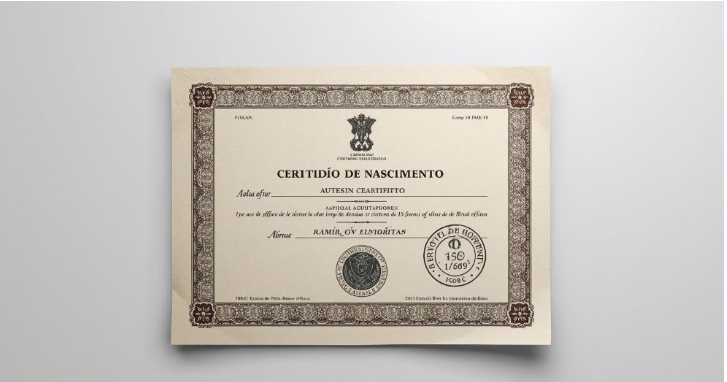
Brazilian naming conventions are a frequent source of confusion for Australian officials. A person may carry their mother's surname followed by their father's surname - the opposite of many European conventions - and some individuals have compound given names that are treated as a single first name in Brazil but may be split into separate fields by Australian systems. Getting these details right in the translation is essential, because any mismatch between the translated certificate and the applicant's passport or visa documents can trigger processing delays.
Multilingual Example - Brazilian Birth Certificate
Original (Portuguese):
Nome: Ana Beatriz Costa Ferreira
Data de nascimento: 03 de setembro de 1996
Naturalidade: Curitiba, Parana
Filiacao: Mae - Juliana Costa; Pai - Ricardo Ferreira
Matricula: 076543 01 55 2021 1 00089 003 0004521 72
Certified Translation (English):
Name: Ana Beatriz Costa Ferreira
Date of Birth: 3 September 1996
Place of Birth: Curitiba, State of Parana
Parentage: Mother - Juliana Costa; Father - Ricardo Ferreira
Registration No.: 076543 01 55 2021 1 00089 003 0004521 72
Translation Pitfalls
The matricula - a long string of numbers unique to each civil registry entry - must be transcribed exactly as it appears. It serves as a national reference number and can be used to verify the document's authenticity. Translators also need to handle the averbacoes carefully: a birth certificate may carry annotations recording a later marriage, a divorce, or a legal name change. If these annotations are not translated, critical information may be missing from the submission.
Marriage Certificate - Certidao de Casamento
Brazilian marriage certificates are most commonly needed for partner visa applications (subclass 309/100 or 820/801), but they also surface in family court proceedings, superannuation claims, and applications to change a registered name in Australia. The certificate is issued by the Cartorio where the marriage was registered and includes the full names of both spouses, their parents' names, the date and place of the ceremony, and the matrimonial property regime (regime de bens) chosen by the couple.
The regime de bens is a legal concept that has no direct equivalent in Australian family law. Brazilian couples choose from several options - comunhao parcial de bens (partial community of property), comunhao universal de bens (universal community of property), separacao total de bens (complete separation of property), or participacao final nos aquestos (participation in acquired assets). A skilled translator will provide the English equivalent alongside the original Portuguese term, allowing Australian legal professionals to interpret the provision correctly.
Multilingual Example - Brazilian Marriage Certificate
Original (Portuguese):
Nubente 1: Lucas Almeida Santos
Nubente 2: Camila Rodrigues Lima
Data do casamento: 14 de fevereiro de 2021
Local: 2o Oficio de Registro Civil, Florianopolis, SC
Regime de bens: Comunhao parcial de bens
Certified Translation (English):
Spouse 1: Lucas Almeida Santos
Spouse 2: Camila Rodrigues Lima
Date of Marriage: 14 February 2021
Place: 2nd Civil Registry Office, Florianopolis, SC
Matrimonial Property Regime: Partial Community of Property
Police Certificate - Certidao de Antecedentes Criminais
Character requirements are a standard part of Australian visa applications. If you have lived in Brazil for 12 months or more (cumulatively) since the age of 16, you will need to provide a police certificate. Brazil has a two-tier system: the federal certificate is issued by the Policia Federal and can usually be obtained online, while state-level certificates are issued by the Secretaria de Seguranca Publica of each state.
Most visa applicants only need the federal certificate, but some subclasses or circumstances may require both. The federal certificate will reference your CPF number (Cadastro de Pessoas Fisicas) - Brazil's individual taxpayer identification number - which appears on virtually every official Brazilian document and must be accurately transcribed in the translation.
Multilingual Example - Brazilian Police Certificate
Original (Portuguese):
Certidao de Antecedentes Criminais
Nome: Lucas Almeida Santos
CPF: 987.654.321-00
Nada consta em relacao ao(a) solicitante nos registros desta Policia Federal.
Certified Translation (English):
Criminal Record Certificate
Name: Lucas Almeida Santos
CPF (Individual Taxpayer Number): 987.654.321-00
No records were found in relation to the applicant in the records of this Federal Police.
Federal vs State Certificates
The federal police certificate (certidao da Policia Federal) covers offences at the national level. State certificates (certidao da Secretaria de Seguranca Publica) cover offences registered within a particular state. If you lived in multiple Brazilian states, you may need separate state-level certificates for each. Your migration agent or the Department of Home Affairs can confirm which certificates are needed for your specific visa subclass.
University and Education Documents
Brazil's higher education system has expanded rapidly, and Australian employers and universities increasingly encounter Brazilian qualifications. The key documents are the diploma (degree certificate) and the historico escolar (academic transcript). Skills assessment bodies like VETASSESS and professional registration authorities require certified translations of both.
Brazilian universities use a grading scale that varies between institutions - some use 0-10, others use letter grades or descriptive classifications such as aprovado (passed), aprovado com distincao (passed with distinction), or reprovado (failed). Degree titles also follow a different structure: a Bacharel is broadly equivalent to a Bachelor's degree, a Licenciatura is a teaching-focused undergraduate degree, and a Tecnologo is a shorter vocational qualification. Translators need to handle these distinctions accurately so that Australian assessors can evaluate them properly.
Multilingual Example - Brazilian Academic Transcript
Original (Portuguese):
Curso: Bacharelado em Engenharia Civil
Instituicao: Universidade Federal do Parana
Conclusao: 15 de dezembro de 2019
Coeficiente de Rendimento Acumulado: 8,4 / 10,0
Certified Translation (English):
Programme: Bachelor of Civil Engineering
Institution: Federal University of Parana
Completion Date: 15 December 2019
Cumulative Grade Point Average: 8.4 / 10.0
Driving Licence - Carteira Nacional de Habilitacao (CNH)
The CNH is a credit-card-sized document issued by the DETRAN (Departamento Estadual de Transito) of each Brazilian state. It includes the holder's photo, CPF number, category of licence (A for motorcycles, B for cars, and so on), and validity dates. Since 2017, Brazil has also offered a digital version (CNH Digital), but Australian road authorities require a translation of the physical document.
Each Australian state has its own rules for how long you can drive on an overseas licence after arriving. In Victoria, VicRoads requires a NAATI certified translation as part of the licence conversion process. New South Wales and Queensland have similar requirements through their respective transport agencies. Both sides of the CNH should be scanned and submitted for translation, as the reverse contains licence category details and restrictions.
Multilingual Example - Brazilian Driving Licence (CNH)
Original (Portuguese):
Carteira Nacional de Habilitacao
Nome: Ana Beatriz Costa Ferreira
CPF: 123.456.789-00
Categoria: B
Validade: 22/09/2027
Certified Translation (English):
National Driving Licence
Name: Ana Beatriz Costa Ferreira
CPF (Individual Taxpayer Number): 123.456.789-00
Category: B (Passenger vehicle)
Valid Until: 22 September 2027
Other Documents Brazilian Migrants Commonly Need Translated
Beyond the core certificates listed above, several other Brazilian documents regularly come across the desk of NAATI certified Portuguese translators:
- Certidao de Obito (Death Certificate) - Required for estate matters, survivor benefits, or where a previous spouse is deceased and the applicant is applying for a new partner visa.
- Certidao de Divorcio / Averbacao de Divorcio - The divorce may be recorded as a separate certificate or as an annotation on the marriage certificate. Both formats need translation.
- Carteira de Trabalho (Employment Record Book) - A unique Brazilian document that records an individual's entire formal employment history. Used for skills assessments and points-tested visa applications.
- Certidao Negativa de Debitos (Tax Clearance Certificate) - Occasionally required for business visa applications or investment visa processes.
- Procuracao (Power of Attorney) - Brazilian powers of attorney often run to several pages and include detailed legal provisions. They may be needed for property transactions or legal representation while the applicant is overseas.
Getting Your Brazilian Documents Translated - Step by Step
The entire process can be completed online from anywhere in Australia. There is no need to visit an office or post original documents.
- Scan or photograph every page of the document. Brazilian Cartorio documents often include stamps, seals, and annotations across multiple pages. Make sure everything is captured - including the reverse of the CNH or any averbacoes in the margins of a birth or marriage certificate.
- Upload the file through a certified translation service. Select the document type and indicate any special requirements - for example, if you need the inteiro teor format translated in full rather than as an extract.
- A NAATI certified Portuguese translator completes the translation. The translator renders the document into English, certifies it with their NAATI practitioner number and stamp, and signs a declaration of accuracy.
- Receive the completed translation as a digital PDF. You can then upload it directly to ImmiAccount, forward it to your migration agent, or submit it to the relevant authority.
Digital Delivery Is Standard
Australian government agencies, universities, and professional registration bodies widely accept NAATI certified translations delivered digitally in PDF format. Physical copies are rarely required unless a specific authority requests them. For more detail, see our guide on digital versus hard copy NAATI translations.
What Does Portuguese Document Translation Cost?
Pricing depends on the service level and the complexity of the document. Brazilian documents - particularly inteiro teor certificates with extensive handwritten annotations - can be more involved than standard certificates from countries with simpler formats.
| Service Type | Starting From | Typical Turnaround |
|---|---|---|
| Self-Service Extract | $44.95 | From 1 hour |
| Extract Translation | $59.95 | 1 business day |
| Full Translation | $64.95 | 1-2 business days |
These turnaround times are indicative and not guaranteed. Multi-page inteiro teor documents, procuracoes, or certificates with extensive handwritten content may take longer. It is worth factoring in processing time when planning around visa lodgement or application deadlines.
Be cautious of providers offering significantly lower prices. If a translator is not NAATI certified, the resulting document will not meet the requirements of Australian authorities - regardless of how accurately it has been translated. The cost of retranslation by a certified professional will outweigh any initial saving.
Mistakes That Delay Brazilian Document Applications
A few recurring issues come up frequently with Brazilian documents:
- Submitting a standard certidao when the inteiro teor is needed. The standard certificate may omit annotations that are relevant to a visa application - such as a recorded divorce or a name change. When in doubt, obtain the inteiro teor version from the Cartorio.
- Forgetting to include the back of the CNH. The reverse of the Brazilian driving licence contains licence category details and restrictions that are needed for the translation. Both sides must be scanned.
- Name mismatches across documents. Brazilian naming conventions - compound given names, dual surnames, name changes upon marriage - can result in slight variations across documents. Ensure your translator is aware of any discrepancies so they can handle them consistently.
- Poor-quality scans of older handwritten documents. Cartorio records from the 1970s and 1980s were often handwritten. Faded ink, cramped handwriting, and worn paper make these documents difficult to translate from a low-quality scan. Use a flatbed scanner if possible, or photograph the document in strong natural light.
- Assuming a sworn translation from Brazil (traducao juramentada) is accepted in Australia. Brazil has its own system of sworn translators (tradutores juramentados), but their certifications are not recognised in Australia. A NAATI certified translation is the Australian standard.
Frequently Asked Questions
Is a Brazilian traducao juramentada accepted in Australia?
No. Brazil's sworn translation system (traducao juramentada) is specific to the Brazilian legal framework and is not recognised by Australian authorities. For use in Australia, documents must be translated by a NAATI certified translator.
Should I get the inteiro teor or the standard certidao translated?
For visa and citizenship applications, the inteiro teor version is generally more useful because it includes all annotations and amendments. If you already have the standard version and are unsure, check with your migration agent or the relevant authority before ordering a translation.
Do I need both federal and state police certificates from Brazil?
In most cases, the federal certificate from the Policia Federal is sufficient. However, certain visa subclasses or specific circumstances may require additional state-level certificates. Confirm with the Department of Home Affairs or your migration agent.
Can I convert my Brazilian CNH to an Australian driving licence?
Yes, but the process varies by state. In Victoria, you apply through VicRoads; in NSW, through Transport for NSW. A NAATI certified translation of the CNH is typically part of the application. You may also need to pass a knowledge test or driving test depending on the state and your licence category.
What is the difference between an extract and a full translation?
An extract translation covers the essential data fields - names, dates, registration numbers - and is suitable for most standard visa and government submissions. A full translation reproduces every element of the original document, including all stamps, seals, handwritten notes, and marginal annotations. Full translations may be preferred for legal proceedings or for complex inteiro teor documents.
Need a Brazilian Document Translated?
Upload your document through our simple online process and a NAATI certified Portuguese translator will handle the rest. If you are unsure which service type suits your document, send through a copy and we will advise.
About the Author
Mariana Ribeiro
NAATI Certified Portuguese-English Translator | Brazilian Document Specialist
Mariana is a NAATI certified Portuguese-English translator with six years' experience in Brazilian civil and legal documents. Born in Curitiba and based in Melbourne, she specialises in Brazil's Cartório registry system.