
Vietnamese to English NAATI Translations – What New Migrants Need to Know

Vietnamese-born Australians represent one of the largest migrant communities in the country, and the flow of new arrivals - skilled workers, students, family reunion applicants, and partner visa holders - continues to grow. Whether you are a software developer from Ho Chi Minh City applying for skills assessment, a nursing graduate from Hanoi preparing AHPRA registration, or a parent lodging a contributory parent visa, your Vietnamese paperwork will need to be in English before any Australian authority can process it.
This guide covers the Vietnamese documents most commonly required for Australian immigration, education, and licensing purposes. It explains how Vietnam's civil registration system works, highlights the translation challenges unique to Vietnamese, and outlines the practical steps for getting a NAATI certified Vietnamese to English translation.
Why Australian Authorities Require NAATI Certification
NAATI - the National Accreditation Authority for Translators and Interpreters - is Australia's only nationally recognised credentialing body for translators. When an organisation like the Department of Home Affairs, a state road authority, or a university enrolment office asks for a "certified translation," they mean one completed by a translator holding current NAATI credentials.
Translations notarised in Vietnam - even those stamped by a Vietnamese notary public (công chứng) - do not satisfy this requirement. Australian bodies are not assessing whether a translation was officially stamped overseas; they want assurance that a qualified professional operating under Australian standards has produced the English version and taken personal accountability for its accuracy.
This applies to every Vietnamese-language document submitted in an official capacity - from a Giấy khai sinh (birth certificate) attached to a visa application to a Bảng điểm (academic transcript) sent to a skills assessment body.
How Vietnam's Civil Registration System Works
In Vietnam, civil registration falls under the jurisdiction of the People's Committee (Ủy ban Nhân dân) at the commune or ward level. Births, marriages, and deaths are registered at the local People's Committee office, which issues the corresponding certificates. For Vietnamese nationals living abroad, civil events can be registered through Vietnamese diplomatic missions.
Vietnam's civil registration has undergone significant modernisation in recent decades. The 2014 Law on Civil Status (Luật Hộ tịch) standardised formats and digitalised record-keeping in many provinces. However, older documents - particularly those issued before the mid-1990s or during periods of political upheaval - may follow different formats, use outdated terminology, or include handwritten entries that vary significantly from current templates.
Another feature of the Vietnamese system is the household registration book (Sổ hộ khẩu), which until recently served as a primary proof of residence and family composition. While the Sổ hộ khẩu system is being phased out in favour of a national population database, many applicants still hold documents linked to it. Translators working with Vietnamese civil documents need to understand this administrative context.
Birth Certificate - Giấy khai sinh
The Vietnamese birth certificate (Giấy khai sinh) is issued by the People's Committee where the birth was registered. It records the child's full name, date and place of birth, gender, ethnicity (dân tộc), nationality, and the parents' details. Vietnam's 54 recognised ethnic groups mean that the ethnicity field - which has no direct Australian equivalent - appears on virtually every civil document and must be translated accurately.
Vietnamese naming conventions differ from Western practice. The family name (họ) comes first, followed by a middle name (tên đệm) and the given name (tên). The given name - the last element - is the one used in everyday address. This ordering is the reverse of English convention and needs careful handling to avoid confusion in Australian systems where "first name" and "last name" carry specific database-field meanings.
Side-by-Side Example - Giấy khai sinh
Vietnamese Original:
Họ và tên: Nguyễn Văn Minh
Ngày sinh: 24 tháng 08 năm 1994
Nơi sinh: Quận 1, Thành phố Hồ Chí Minh
Giới tính: Nam
Dân tộc: Kinh
Quốc tịch: Việt Nam
English Translation:
Full Name: Nguyen Van Minh
Date of Birth: 24 August 1994
Place of Birth: District 1, Ho Chi Minh City
Gender: Male
Ethnicity: Kinh
Nationality: Vietnamese
Diacritical Marks and Romanisation
Vietnamese uses the Latin alphabet but with extensive diacritical marks - tone marks and modified vowels that fundamentally change meaning. Nguyễn is not the same as Nguyen in Vietnamese, though Australian systems routinely strip diacritics. A skilled translator will render names accurately while noting how they are likely to appear in Australian records, helping applicants avoid identity mismatches across their document set.
Marriage Certificate - Giấy chứng nhận kết hôn
Vietnamese marriage certificates (Giấy chứng nhận kết hôn) are issued by the People's Committee at the district level. They record both spouses' full names, dates of birth, nationalities, permanent addresses, and the date and place of marriage registration. Marriages involving a foreign national are registered at the provincial-level Department of Justice (Sở Tư pháp).
Partner visa applicants - particularly those applying under subclass 309/100 (offshore) or 820/801 (onshore) - regularly need this document translated. An important detail for Australian case officers is that Vietnamese law does not automatically change a spouse's surname upon marriage. Both parties retain their birth names unless a separate legal name change is applied for. This means the names on a marriage certificate will usually match the names on each spouse's birth certificate - unlike in many Western countries where a new married name appears.
Side-by-Side Example - Giấy chứng nhận kết hôn
Vietnamese Original:
Bên A: Nguyễn Văn Minh
Ngày sinh: 24/08/1994
Bên B: Trần Thị Lan
Ngày sinh: 11/03/1996
Ngày đăng ký: 15 tháng 06 năm 2021
Nơi đăng ký: UBND Quận Bình Thạnh, TP. Hồ Chí Minh
English Translation:
Party A: Nguyen Van Minh
Date of Birth: 24 August 1994
Party B: Tran Thi Lan
Date of Birth: 11 March 1996
Date of Registration: 15 June 2021
Place of Registration: People's Committee, Binh Thanh District, Ho Chi Minh City
Police Clearance - Phiếu lý lịch tư pháp
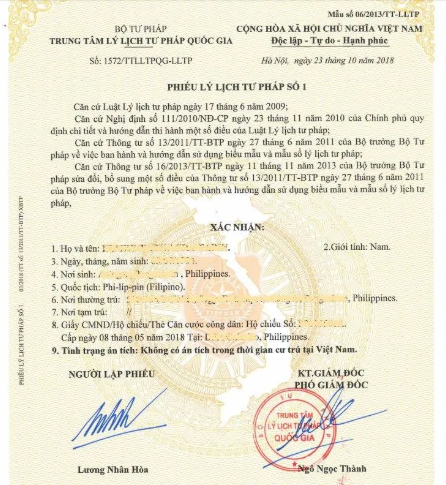
Vietnam's police clearance is officially called the Phiếu lý lịch tư pháp - the Judicial Record Certificate. It is not issued by the police but by the Department of Justice (Sở Tư pháp) at the provincial level, or by the National Centre for Criminal Records under the Ministry of Justice for applicants residing abroad.
The Department of Home Affairs requires a police certificate from every country where a visa applicant has lived for 12 months or more (cumulatively) since turning 16. For Vietnamese nationals, this means obtaining the Phiếu lý lịch tư pháp - specifically the type known as Phiếu lý lịch tư pháp số 2, which provides a more detailed criminal record check than the basic version (số 1).
Side-by-Side Example - Phiếu lý lịch tư pháp
Vietnamese Original:
Phiếu lý lịch tư pháp số 2
Họ và tên: Nguyễn Văn Minh
Ngày sinh: 24/08/1994
Tình trạng án tích: Không có án tích
English Translation:
Judicial Record Certificate No. 2
Full Name: Nguyen Van Minh
Date of Birth: 24 August 1994
Criminal Record Status: No criminal record
Key Translation Detail
The clean-record phrase "Không có án tích" is the standard declaration that no criminal convictions exist. It should be rendered clearly as "No criminal record" - not as an ambiguous literal translation. The distinction between số 1 and số 2 versions should also be noted in translation, as Australian case officers may query which type was submitted.
Academic Qualifications and Transcripts
Vietnam's higher education system awards the Bằng cử nhân (bachelor's degree), Bằng thạc sĩ (master's degree), and Bằng tiến sĩ (doctorate). Academic transcripts (Bảng điểm) use a 10-point grading scale, where 9–10 is Xuất sắc (Excellent), 7–8 is Khá (Good), 5–6 is Trung bình (Average), and below 5 is a fail.
Australian skills assessment bodies - including VETASSESS, Engineers Australia, the Australian Computer Society, and others - require certified translations of Vietnamese academic documents. The grading scale, qualification names, and institutional classifications (public university vs. people-founded university vs. private university) all need precise rendering so assessors can make accurate comparisons.
Side-by-Side Example - Academic Transcript
Vietnamese Original:
Bảng điểm
Họ và tên: Nguyễn Văn Minh
Ngành: Công nghệ thông tin
Trường: Đại học Bách khoa TP. Hồ Chí Minh
Điểm trung bình: 7.8 (Khá)
English Translation:
Academic Transcript
Full Name: Nguyen Van Minh
Major: Information Technology
Institution: Ho Chi Minh City University of Technology
Grade Point Average: 7.8 (Good)
Driving Licence - Giấy phép lái xe
The Vietnamese driving licence (Giấy phép lái xe) is issued by the Department of Transport (Sở Giao thông Vận tải) at the provincial level. Licence categories include B1 and B2 for passenger vehicles, C for trucks, and D for buses. The most common categories among migrants converting to an Australian licence are B1 (automatic only) and B2 (manual and automatic).
Each Australian state sets its own rules for overseas licence conversion. In New South Wales, you apply through Transport for NSW. In Victoria, through VicRoads. In Queensland, through the Department of Transport and Main Roads. All require a NAATI certified translation of the licence as part of the application, regardless of whether the licence includes any English text.
Side-by-Side Example - Giấy phép lái xe
Vietnamese Original:
Giấy phép lái xe
Họ và tên: Nguyễn Văn Minh
Ngày sinh: 24/08/1994
Hạng: B2
Có giá trị đến: 24/08/2029
English Translation:
Driving Licence
Full Name: Nguyen Van Minh
Date of Birth: 24 August 1994
Category: B2 (Manual and automatic passenger vehicle)
Valid Until: 24 August 2029
What Makes Vietnamese Translation Distinctive
Vietnamese presents several challenges that set it apart from most other languages translated for Australian purposes:
- Tonal diacritics: Vietnamese has six tones, marked by diacritics that change word meaning entirely. Ma (ghost), Má (mother), Mà (but), Mả (grave), Mã (horse), and Mạ (rice seedling) are all different words. Dropping or misplacing a diacritic is not a minor formatting issue - it can change a name or a legal term.
- Name order: Family name first, given name last. Nguyễn Văn Minh is Mr Minh, not Mr Nguyễn. Getting this wrong in an Australian form can create cascading identity mismatches.
- Administrative terminology: Terms like Ủy ban Nhân dân (People's Committee), Sở Tư pháp (Department of Justice), and Công an (Public Security/Police) have no direct Australian equivalents and require contextual translation rather than literal word-for-word rendering.
- Historical document variation: Documents issued before Đổi Mới (the 1986 economic reforms) or during earlier periods may use different formats, institutional names, and even place names that have since changed.
Diacritics Matter
Australian databases frequently strip Vietnamese diacritics, recording Nguyễn as Nguyen and Hồ Chí Minh as Ho Chi Minh. A good translator will render the full diacritical form while also noting the commonly used non-diacritical version, helping applicants maintain consistency across their documentation.
Other Vietnamese Documents Commonly Requiring Translation
Beyond the core documents above, Vietnamese migrants in Australia frequently need translations of:
- Giấy xác nhận tình trạng hôn nhân - Certificate of marital status, commonly required for partner visa applications to confirm the applicant is not currently married to another person in Vietnam.
- Bản án ly hôn - Divorce judgement, issued by the People's Court. Vietnamese divorce documents can include detailed rulings on property division, child custody, and financial obligations.
- Sổ hộ khẩu - Household registration book. Although being phased out, many existing applications and records still reference this document, which lists all registered household members.
- Giấy chứng nhận quyền sử dụng đất - Land use right certificate (commonly called the "red book"). Relevant for financial or investment-related visa applications.
- Giấy chứng tử - Death certificate, needed for estate matters, remarriage applications, or visa applications where a previous spouse is deceased.
How to Get Your Vietnamese Documents Translated
The process is entirely online - you do not need to attend an office, and your location within Australia (or overseas) does not matter.
- Take a clear scan or photo of your document. Ensure all text, stamps, and red seals (con dấu đỏ) are fully legible. Vietnamese documents often feature red ink stamps that can be difficult to read if photographed at an angle or in low light.
- Upload through a translation provider. Submit the file through a NAATI certified translation service and choose the service level appropriate to your needs.
- A NAATI certified translator produces the translation. The translator converts the document into English, certifies it, and attaches their NAATI practitioner number and stamp.
- Receive the certified translation by email. The finished translation is delivered as a PDF. Australian authorities broadly accept digital NAATI certified translations - you only need a hard copy if the specific organisation explicitly requires one.
PDF Delivery Is the Norm
The Department of Home Affairs accepts uploads through ImmiAccount, and most universities and skills assessment bodies work with digital files. Posting physical translations is rarely necessary. For more on this, see our guide on digital versus hard copy NAATI translations.
What Does a Vietnamese to English Translation Cost?
Pricing depends on the service type and the complexity of the original document. Here is a general overview:
| Service Level | Price From | Indicative Turnaround |
|---|---|---|
| Self-Service Extract | $44.95 | From 1 hour |
| Extract Translation | $59.95 | 1 business day |
| Full Translation | $64.95 | 1–2 business days |
Turnaround times are indicative and are not guaranteed. Multi-page documents such as academic transcripts or divorce judgements may require additional time.
When comparing providers, check whether the price includes NAATI certification and digital delivery. A cheaper translation from a non-NAATI source will not be accepted by Australian authorities, which ultimately costs more in resubmission fees and processing delays.
Mistakes That Hold Up Vietnamese Document Applications
These are the issues that most frequently cause delays or rejections when submitting Vietnamese documents in Australia:
- Reversing the name order. Listing Nguyễn Văn Minh as "Nguyen" (given name) and "Van Minh" (surname) creates identity mismatches that can delay a visa application by weeks.
- Submitting a notarised Vietnamese translation instead of a NAATI certified one. Translations stamped by a Vietnamese công chứng viên (notary public) are not recognised in Australia. NAATI certification is a separate standard.
- Providing blurry photos of documents with red seals. Vietnamese official documents rely heavily on red ink stamps (con dấu đỏ). If the stamp text is illegible in the scan, the translator cannot certify it and the receiving authority may question the document's authenticity.
- Omitting the Sổ hộ khẩu when relevant. Although being phased out, some applications still reference household registration details. If a receiving authority requests it, failing to include a translated copy can stall the process.
- Requesting the wrong type of police clearance. The Phiếu lý lịch tư pháp số 1 (basic version) may not be sufficient - the Department of Home Affairs typically expects số 2 (the detailed version).
Frequently Asked Questions
Is a NAATI certified translation required for my Vietnamese birth certificate?
For any submission to an Australian government agency, university, or professional body - yes. A translation without NAATI certification will generally not be accepted.
Can I convert my Vietnamese driving licence in Australia?
Yes, but you will need a NAATI certified translation of your Giấy phép lái xe. The conversion process and any testing requirements vary by state. Check with your local road authority for specifics.
Will a translation notarised in Vietnam be accepted in Australia?
No. Australian authorities require NAATI certification, which is a separate standard from Vietnamese notarisation (công chứng). You will need a fresh translation completed by a NAATI certified translator.
Does the Department of Home Affairs accept digitally delivered translations?
Yes. PDF translations can be uploaded directly through ImmiAccount. Hard copies are only needed if a specific authority explicitly requests them.
How should Vietnamese names appear on translated documents?
The full name should be transliterated as it appears on the original document. The translator should clarify that the family name (họ) appears first and the given name (tên) appears last, helping Australian authorities correctly populate their records.
Need a Vietnamese Document Translated?
Upload your Vietnamese document through our online ordering page and select the service level that suits your timeline. Our NAATI certified Vietnamese translators handle everything from recent People's Committee certificates to older pre-reform documents.
About the Author
Dr Linh Tran
NAATI Certified Vietnamese-English Translator | Migration Document Specialist
Dr Linh Tran is a NAATI certified Vietnamese-English translator with nine years' experience in Vietnamese civil and academic documents. She holds a PhD in Applied Linguistics from Monash University.